

Ferrari’s first electric car was never going to be judged by whether it was fast; it was always going to be judged by whether it still felt dangerous to desire.
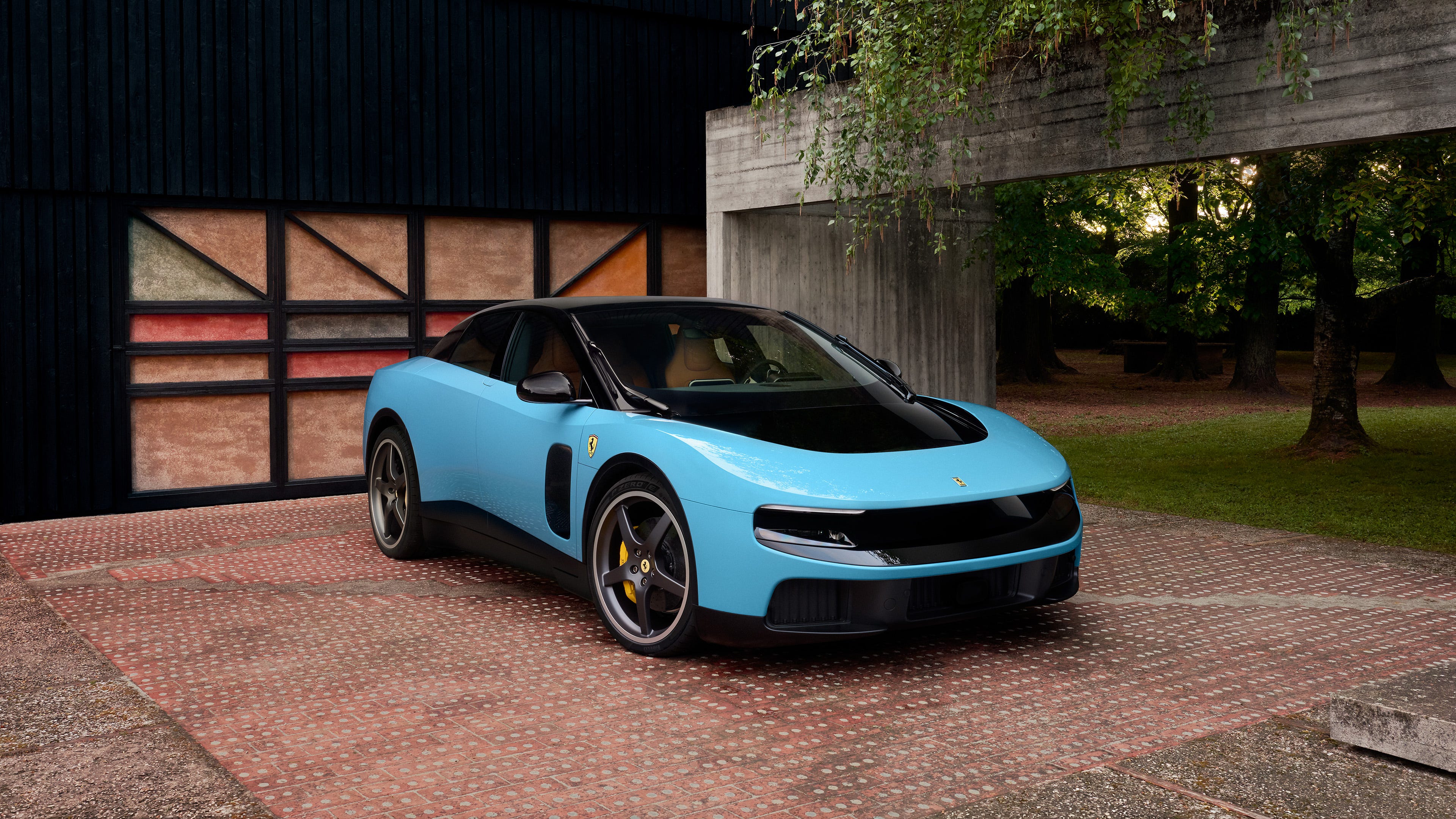
Ferrari has revealed the Luce, its first fully electric production car and one of the most consequential departures in the company’s modern history. It is a four-door, five-seat Ferrari built on a dedicated electric platform, powered by four electric motors, one for each wheel.
The company says the Luce produces 1,050 cv, reaches 0–100 km/h in 2.5 seconds, 0–200 km/h in 6.8 seconds, and exceeds 310 km/h, or roughly 190 mph. It uses a 122 kWh battery, an 800-volt electrical architecture, and offers a claimed range of more than 530 km, or about 330 miles.
It is also not cheap, even by Ferrari standards. The reported starting price is roughly €550,000 in Italy, or about $640,000.
But does any of this matter?
Well, the Luce matters because Ferrari has chosen the hardest possible way to enter the electric age: Ferrari has made something strange and revealing: a glass-heavy, five-seat, four-motor electric machine that asks whether the essential Ferrari experience can survive without the thing most people think defines it, the engine.
That’s the wholly uncomfortable brilliance of the Luce. It attacks Ferrari’s own mythology.
For decades, Maranello has traded not only on speed, but on combustion as theater: induction, revs, exhaust, heat, vibration, the slight sense that expensive machinery is conducting a private argument just behind the firewall. The Luce has none of that in the old sense. So Ferrari has had to answer a brutal question: what remains when the noise is no longer there to do the emotional heavy lifting?
The answer, at least on paper, is control. Four motors. Four-wheel steering. Active suspension. Torque vectoring. Regenerative braking calibrated as a driving tool. A sound system that does not fake a V12, but amplifies the natural mechanical vibration of the electric axles.
That is the real story. The Luce is not Ferrari surrendering to the EV market. It is Ferrari trying to civilize electricity without letting it become anonymous.
On paper, the Luce should be absurdly quick. That part is easy. Plenty of electric cars can now launch like they have been fired from a railgun. The more interesting question is whether it can make speed feel earned.
Ferrari appears to understand the danger. The great flaw of many performance EVs is not that they are slow, but that they are too simple. Press pedal. Receive violence. Repeat until the novelty wears off.
The Luce tries to restore some authorship to the driver. Its Torque Shift Engagement system uses steering-wheel paddles not to simulate gears, but to let the driver choose levels of available torque and regenerative braking. That may sound like software theater, but it is potentially important. A great driver’s car is not merely one that obeys; it is one that asks for decisions.
The right paddle increases available torque. The left paddle adjusts energy recovery and deceleration. In theory, that gives the driver a way to shape corner entry and exit, rather than simply managing a giant on/off switch disguised as an accelerator.
If Ferrari gets this right, the Luce could feel less like an EV with a Ferrari badge and more like a new dialect of Ferrari. Not Italian opera, perhaps. More like a Stradivarius plugged into an amplifier: still string, still vibration, still intent; but altered.
The open question is weight. At a claimed 2,260 kg, the Luce is not light. Ferrari says its low center of gravity, lower yaw inertia compared with the Purosangue, active systems, and torque control help make it feel more agile than the number suggests. That may be true. Modern chassis systems can perform witchcraft. But physics is not dead; it has merely hired a software engineer.
For buyers, the real test will be whether the Luce feels alive at 45 mph, not merely astonishing at 145.
The Market Context
The timing is a bit awkward.
The broader EV market has cooled, especially in the United States. Several luxury and performance brands have slowed their electric ambitions. Porsche has had to wrestle with softer demand for electric sports cars. Lamborghini and McLaren have been cautious about whether their customers are truly ready for battery-only exotica. (I am not, and never will be.)
Ferrari, meanwhile, has gone ahead and built a $640,000 electric object with glass everywhere, five seats, Jony Ive design involvement, and no internal combustion engine.
That sounds mad until you remember Ferrari’s business model. Ferrari does not need to win a mass-market EV war. It needs to make a small number of very wealthy people believe that this car belongs in the same emotional universe as the rest of their collection.
The harder question is secondhand value.
Ferrari’s mythology is built on permanence. The company often notes that the vast majority of its cars are still on the road. But EV technology ages differently from combustion hardware. Batteries, software, displays, charging standards, and electronics can date a car faster than leather, aluminum, and a naturally aspirated V12 ever did.
Ferrari knows this, which is why its long-term support for the Luce’s battery and electronics may prove nearly as important as its acceleration figures. If a Ferrari is supposed to be “forever,” then an electric Ferrari must be engineered not only to perform, but to age with dignity.
That may be the true luxury challenge here.
The Ferrari Luce is exciting, but not in the same way a new mid-engine Ferrari is exciting.
It’s not the car you buy because you want the purest expression of Maranello noise and mechanical fury. It is the car you consider because Ferrari has decided to stop pretending the electric future can be ignored.
There is plenty to be skeptical about. The weight is enormous. The design will divide people. The price is mountainous. The glass-heavy aesthetic could age brilliantly or badly.
In the end, the Luce may not be the Ferrari traditionalists asked for. But it may be the one Ferrari needed to build first: not a replacement for combustion, but a declaration that electric performance does not have to mean emotional sterilization.
Time will tell. The Luce is Ferrari asking whether electricity can have a soul. Sadly, that answer won’t be found in a spec sheet.
Rev up your passion for automotive art! Everyday Driven is an affiliate of Limited100, the brand turning British craftsmanship into stunning, must-have pieces of art for car lovers worldwide.
Plus, by using our affiliate links, you’ll be supporting Everyday Driven without any ads or subscriptions. Every purchase helps keep our content free and rolling. Check out their site now and find your next favorite piece! Explore their collection and bring home art that speaks to your love for cars.
And you know what would look good on your wall? Ferrari Wall Art from Limited100!