

There are concept cars, and then there are declarations.
Project Nightingale is the latter.
With this new Coachbuild Collection, Rolls-Royce has something that feels less like a product launch and more like aristocratic confidence: a vast, open two-seat electric grand tourer, shaped by Streamline Moderne, haunted by the marque’s 1920s experimental cars, and aimed squarely at the kind of client for whom “limited production” is the entire point of buying one.
Only 100 will be made. Access is by invitation. Deliveries begin in 2028.
Named after Le Rossignol, the house near Henry Royce’s winter home on the Côte d’Azur where designers and engineers once flocked, Project Nightingale is the opening chapter in a new Coachbuild Collection story. Rolls-Royce calls it a production concept, which in practice means the vision is already nearly complete, but a few details still require manufacturing methods that do not yet quite exist. A small inconvenience. But the company seems intent on solving it.
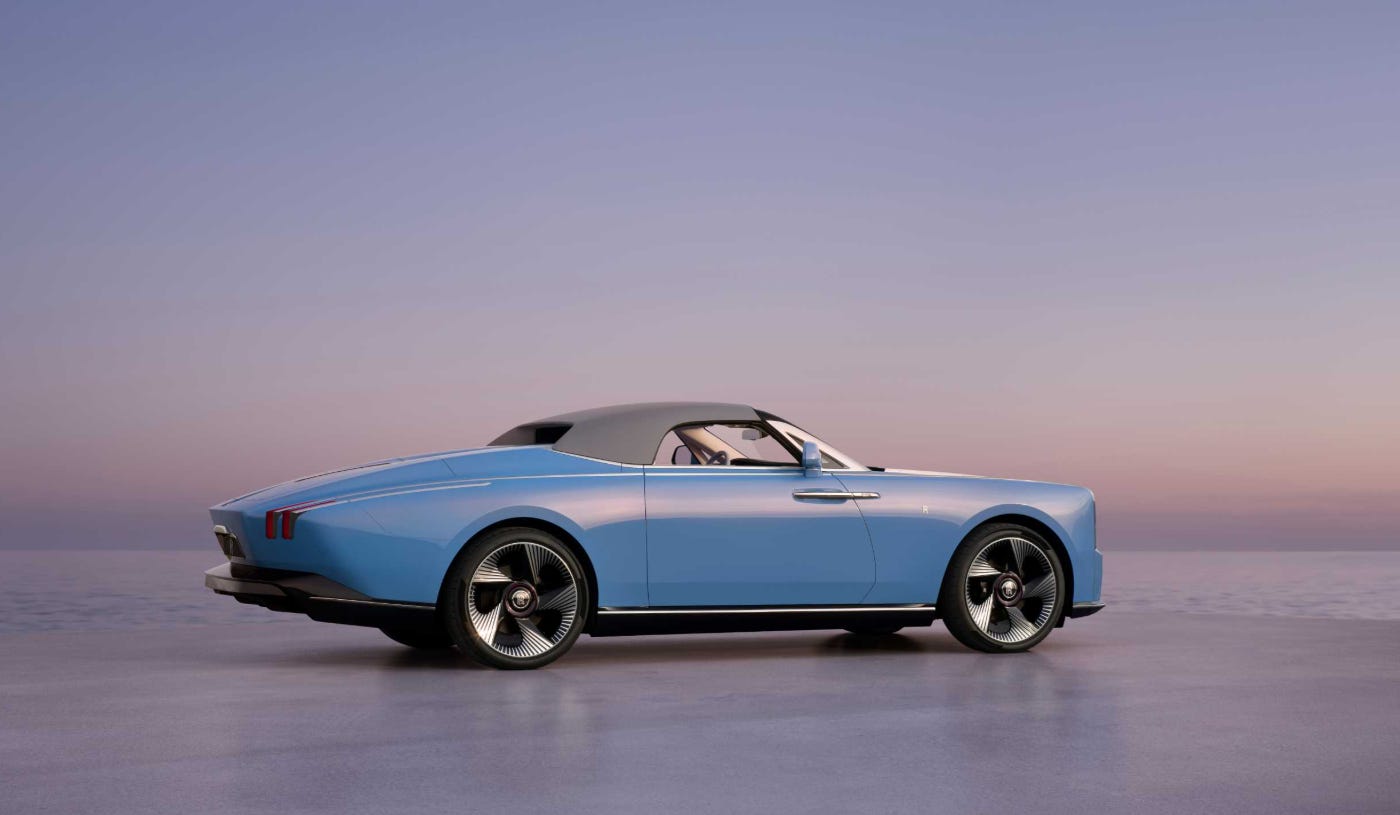
Not a convertible. A statement.
Project Nightingale is almost exactly the length of a Phantom, which tells you nearly everything you need to know about Rolls-Royce’s priorities. This is not a neat little roadster or some dainty Riviera toy. It is a full-scale motor car, devoted entirely to two people and their sense of occasion.
The proportions are gloriously excessive. Long hood. Tight cabin. Sweeping rear deck. The kind of silhouette that suggests speed, ceremony, and inherited money, all in equal measure.
Underneath sits Rolls-Royce’s aluminum Architecture of Luxury spaceframe and a fully electric drivetrain, a choice that is doing more here than merely keeping regulators happy. Electric propulsion is central to the car’s whole character. Without the cooling demands of a combustion engine, the designers were freed to create huge, uninterrupted surfaces across the front of the car. Without exhaust, the rear could be sculpted with extraordinary cleanliness. And without engine noise, open-top motoring becomes something close to serenity.
Rolls-Royce is not pitching Project Nightingale as some loud, extroverted hyper-EV for hedge fund adolescents. It is selling silence, poise, and presence. Or rather, silence, poise, and presence for people wealthy enough to be bored by everything else. Perhaps the only thing you’ll hear at 60 miles per hour is the ticking of the clock.
The ghosts of 16EX and 17EX
The design inspiration comes partly from Streamline Moderne, that late Art Deco discipline in which clean volume and controlled surfaces matter more than ornament. But Nightingale is also looking further back, to the company’s experimental “EX” cars of the late 1920s.
Those cars, especially 16EX and 17EX, were built at the height of the Jazz Age and wore lightweight aluminum bodies over powerful Phantom chassis in pursuit of greater speed. They were torpedo-shaped, ambitious, and a bit outrageous. Exactly the sort of thing a serious car company does when it wants to prove it still has a pulse.
Rolls-Royce has borrowed three key ideas from them.
First: upright to flowing: the formal verticality of the Pantheon grill melting into a long, tapering rear.
Second: central fuselage: one unbroken visual line running from front to back, like the hull of a yacht.
Third: flying wings: sculptural volumes that build tension into the body and draw the eye rearward.
The result is a car that carries Rolls-Royce DNA without looking trapped by it.
A front end with no need to shout
The front elevation is maybe the clearest sign that this is not merely another Rolls with the roof chopped off. Because there is no internal combustion engine to feed, the usual visual clutter of intakes and cooling apertures has been mostly erased. What remains is expanse. Discipline. Surface.
The Pantheon grill, almost a meter wide, looks as though it has been machined from a single block of stainless steel. Twenty-four deep-set vanes sit within it, while the Spirit of Ecstasy is integrated into the upper section in a way that makes the metal seem to flow backward around her, like water parting at speed. It is a theatrical touch that works.
Below, the lower structure widens and drops with geometric precision, supporting a projecting carbon-fiber apron edged in chrome. Rolls-Royce likens it to the structural base beneath the decorative crown of an Art Deco skyscraper, which is exactly the sort of comparison one expects from a company that understands its clients would rather hear about architecture than airflow.
At the outer edges sit perhaps the boldest detail of all: slim, vertically oriented headlamps, bracketed by polished stainless-steel bands that run the full length of the car to the tail lamps. It is a strong move. Maybe even the strongest on the car.
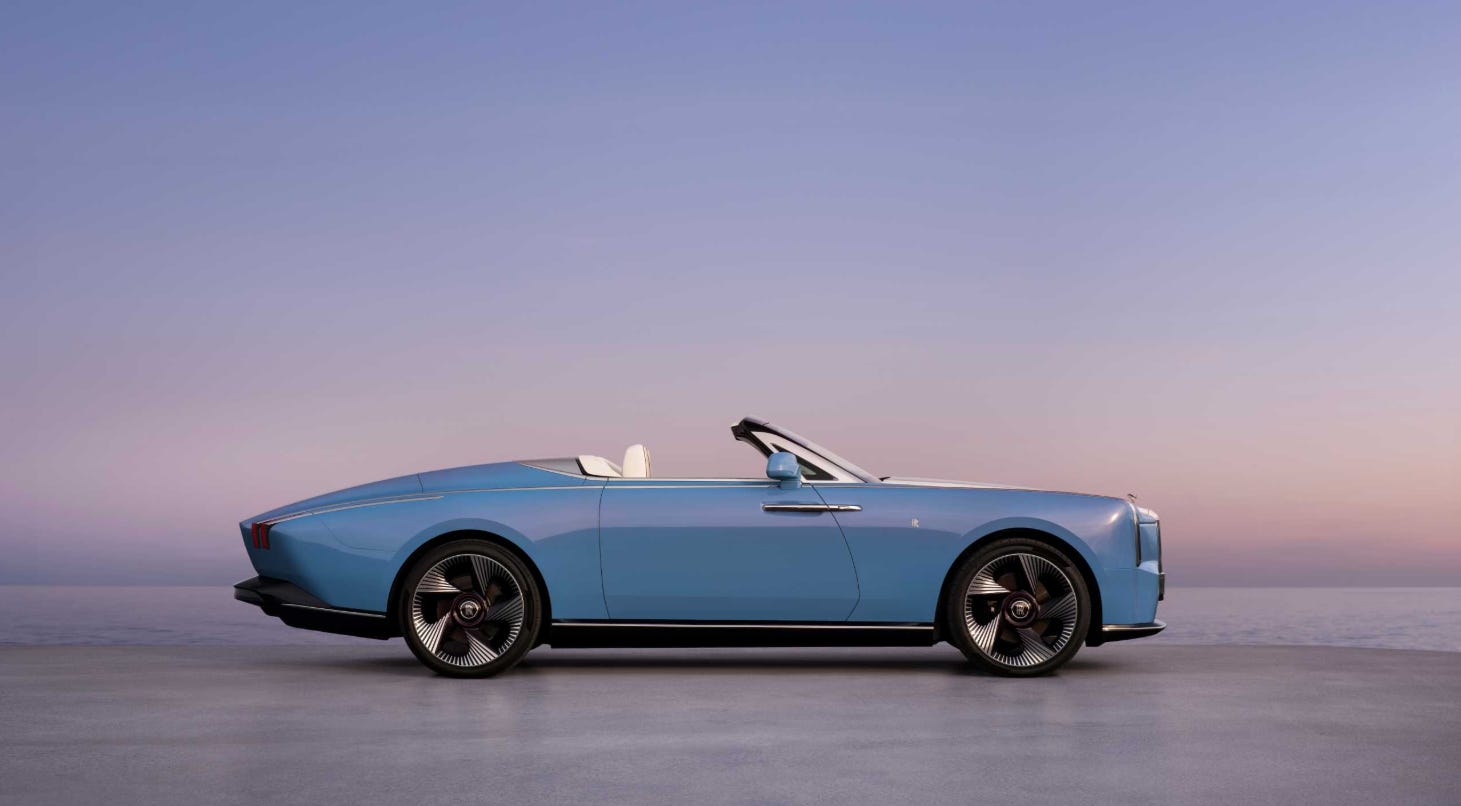
In profile, it becomes clear what the whole thing is about
Seen from the side, Project Nightingale stops pretending to be practical and becomes something more interesting.
The hood stretches on. The windshield is dramatically raked. The cabin is compact, intimate, almost tucked into the bodywork rather than placed on top of it. Behind the seats, the body rises in a protective sweep before the rear deck tapers away to an improbably low trailing edge.
It is, in effect, a giant electric torpedo with a leather-lined cockpit.
A single hull line begins at the sculpted front-wing “Pinnacles” and runs uninterrupted to the rear, deliberately set high to make those inside feel enveloped. Beneath it, the lower body is carved away to reinforce the sense of a central fuselage, balanced by a carbon-fiber sill that quietly nods to the running boards of Rolls-Royce’s older cars.
The details have been handled quite remarkably. Door handles incorporate hidden lock mechanisms and discreet indicator lamps. The usual Rolls-Royce badging is reduced to a polished stainless-steel Double R. Even the 24-inch wheels, the largest ever fitted to a Rolls-Royce, have been shaped with spirit of yacht propellers and wire wheels in motion.
This is not minimalism in the traditional sense. It is minimalism with private aviation money behind it.
The rear is where the confidence shows
Many luxury cars lose their nerve at the back. Designers become busy. Surfaces get messy. Features multiply.
Project Nightingale does not suffer from that problem.
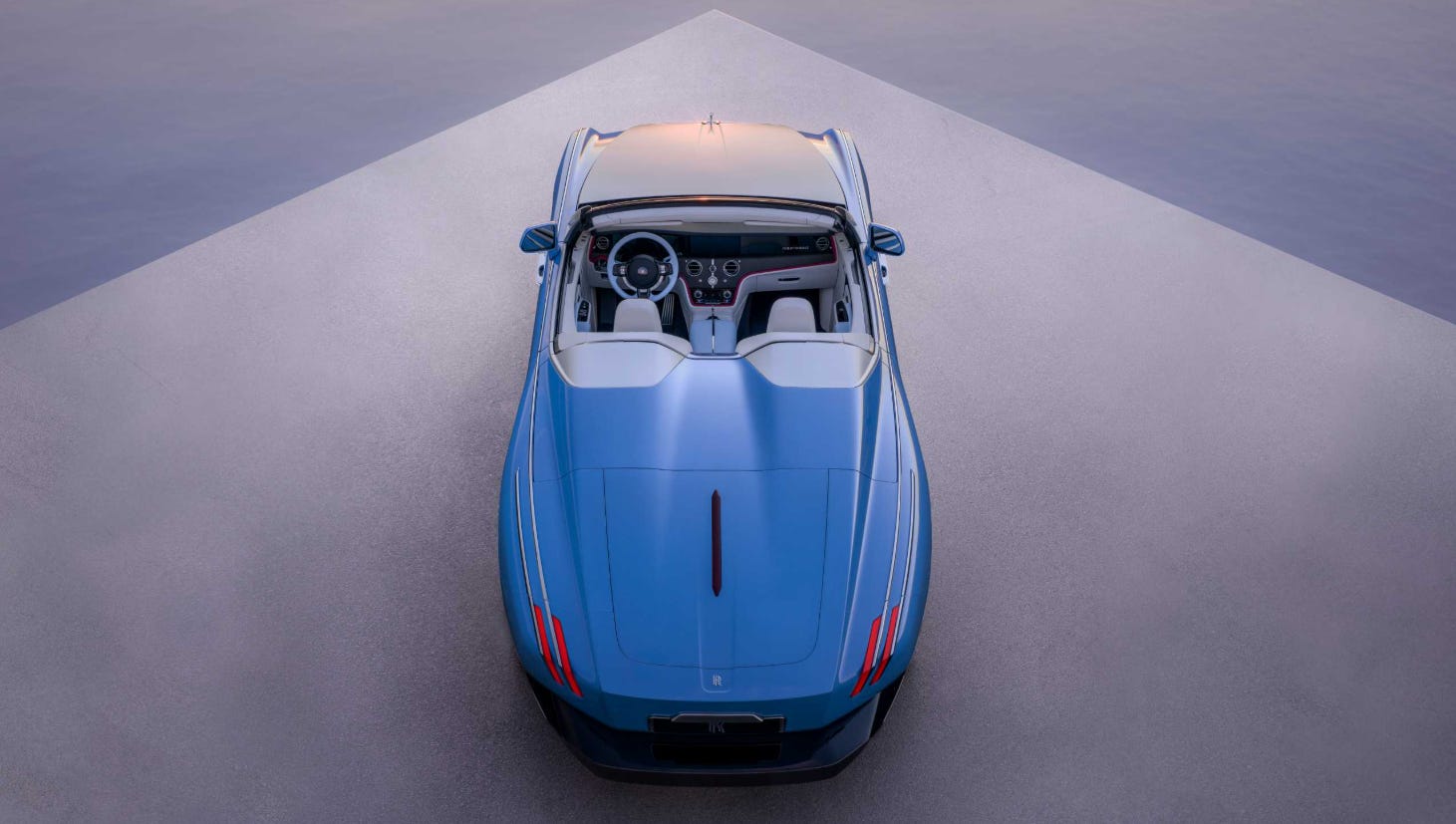
The rear haunches swell with muscular intent, but the deck remains clean and horizontal. The taillamps are slim and sharply resolved, dropping from the upper surface almost at a right angle. A single longitudinal brake light runs down the centerline, a small but effective nod to the speed stripes of Streamline Moderne design.
Then there is the “Piano Boot,” which opens sideways on a cantilever. Rolls-Royce, being Rolls-Royce, cannot simply let the trunk open like an ordinary trunk. It must instead transform luggage access into a ceremonial event.
The rear diffuser, called the Aero Afterdeck, is formed as a single carbon-fiber piece. Because the electric drivetrain eliminates the need for exhaust, the company has been able to achieve high-speed stability without resorting to some vulgar spoiler that would interrupt the silhouette.
That matters. On a car like this, preserving the line is the whole game.
With the roof down, the silence becomes the feature
Most convertibles sell you noise. Wind. Engine. Exhaust. The sensory overload of being in something expensive and visible.
Project Nightingale goes in the opposite direction.
With the roof lowered, Rolls-Royce says the experience is closer to sailing than driving. With virtually no mechanical noise from the electric drivetrain and very little wind disturbance, what remains is not absence but environment. Ocean waves. Air moving through trees. The hush of countryside at speed.
That last detail became important.
During early prototype drives, Rolls-Royce designers noticed they could hear birds with unusual clarity. They began studying recordings of nightingales and analyzing the waveforms of their songs. This could, in less careful hands, have become unbearable nonsense. Instead, it led to one of the car’s most distinctive interior ideas.
Inside: a world for two, lit by birdsong
The interior’s centerpiece is called the Starlight Breeze suite, which sounds like a fragrance sold in Monaco but is actually a constellation of 10,500 tiny illuminated points arranged in patterns derived from nightingale song waves.
These lights wrap around the occupants from the doors and behind the seats, turning melody into ambient architecture. The effect is housed within what Rolls-Royce calls the “Horseshoe,” a sculptural form that rises behind the seats and frames the cabin in a protective embrace.
Yes, it all sounds impossibly mannered. Yes, it is probably magnificent in person.
Elsewhere, the cabin continues the same theme of tactile restraint. The door card leather is raised like a saddle. The center console carries a leather-covered saddle armrest split delicately into two sections. When the coach door opens, the armrest glides rearward to reveal the Spirit of Ecstasy rotary controller, finished in stainless steel with grooves inspired by haute joaillerie. The same jewelled treatment appears on the gear selector and the few remaining controls.
There are only five rotary controls in total, which is perhaps the most convincing evidence yet that true luxury lies in not having to look at too many buttons.
A concealed compartment appears at the touch of a button. Cupholders are machined from billet aluminum. There is even a hidden shelf behind the seats for hand luggage, because this is, we are repeatedly reminded, a motor car for long and unhurried journeys.
In other words, Riviera weekends, not school runs.
The car shown today is just one interpretation
The example revealed by Rolls-Royce is finished in Côte d’Azur Blue, a pale solid blue inspired by the 1928 17EX, though not directly copied from it. Subtle red flakes in the paint reference the red badges worn by the historic EX cars and now used on Project Nightingale to mark its status.
The interior takes its cues from the Côte d’Azur as well, blending Charles Blue, Grace White, Deep Navy, and small flashes of Peony Pink. Openpore Blackwood veneer is laid in an upward-opening V pattern to draw the eye skyward.
Which is all very elegant, very French Riviera, and exactly what one would hope from a car named after a songbird and a house on the Côte d’Azur.
The real point
Project Nightingale is not merely a new Rolls-Royce. It is Rolls-Royce making a broader argument about what its future clients want.
Not more horsepower figures. Not another oversized SUV. Not techno-brutalist gimmickry. Something rarer: a motor car in which design is the main event.
That is why entry is by invitation only. That is why the car is limited to 100 examples. That is why clients are already being drawn into a multi-year program of private events and curated experiences, not simply handed an order form and a paint chart.
This is less a sales process and more courtship.
And perhaps that is fitting. Project Nightingale is named for a bird, shaped like a yacht, inspired by 1920s speed machines, powered by electricity, and intended for people who believe beauty is not just something to own but something to drive.
Which, when you put it that way, sounds exactly like the kind of thing Rolls-Royce should be building.
If you liked this story, you might like my book. Available on Amazon - Kindle or Paperback.
Rev up your passion for automotive art! Everyday Driven is an affiliate of Limited100, the brand turning British craftsmanship into stunning, must-have pieces of art for car lovers worldwide.
Plus, by using our affiliate links, you’ll be supporting Everyday Driven without any ads or subscriptions. Every purchase helps keep our content free and rolling. Check out their site now and find your next favorite piece! Explore their collection and bring home art that speaks to your love for cars.
And you know what would look good on your wall? Rolls-Royce Wall Art from Limited100!