

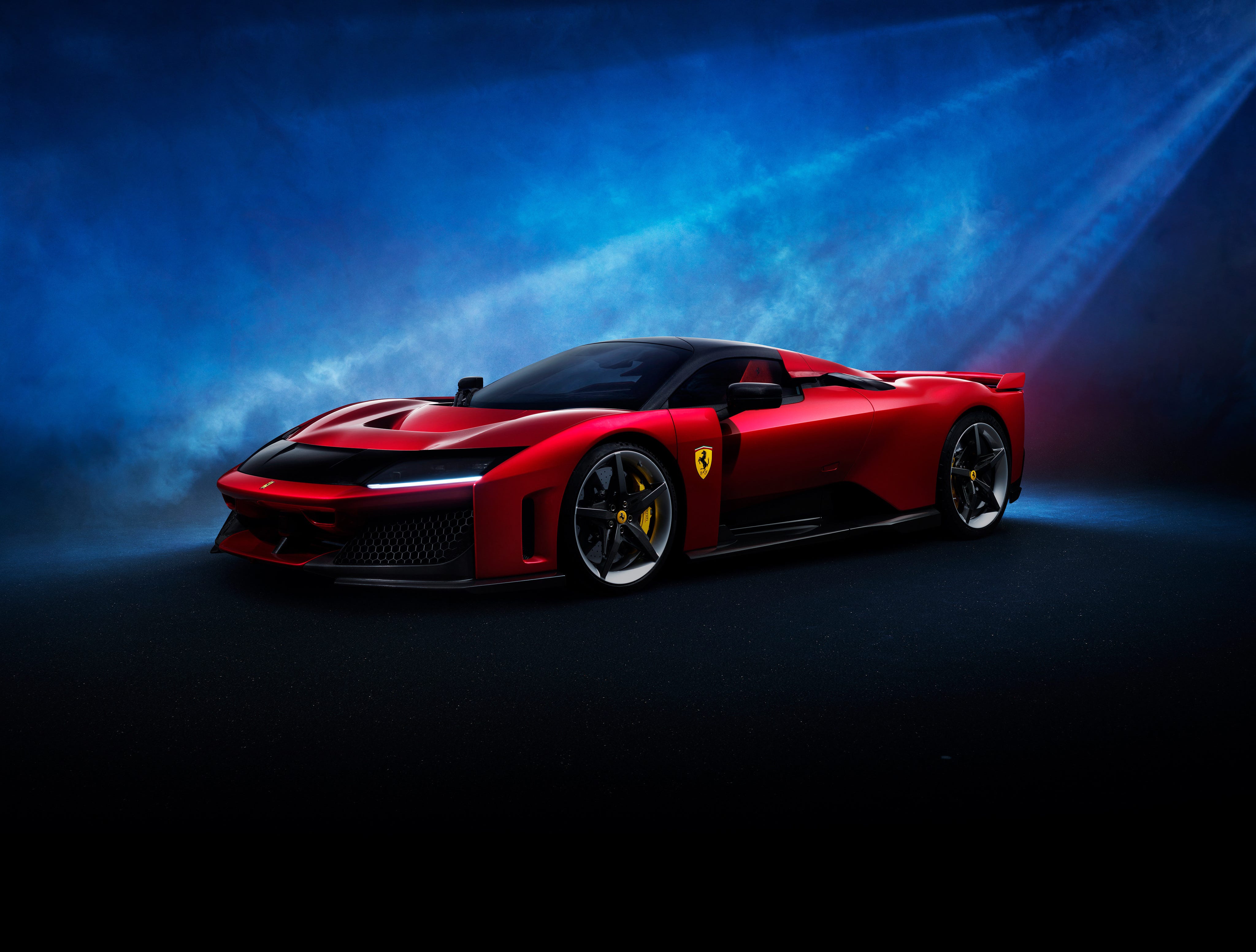
Many probably wouldn’t think of Ferrari’s F80 as a successor to the LaFerrari so much as it is a rolling argument that the internal combustion engine still has one last, violent, exquisitely complicated act left to perform.
The F80, a limited-production hybrid supercar that sits among the company’s highest bloodlines: the lineage of the 288 GTO, F40, F50, Enzo, and LaFerrari.
Only 799 examples will be built. The headline figure is suitably theatrical: 1,200 hp from a hybrid system built around a 3.0-liter twin-turbo V6, three electric motors, all-wheel drive, active aerodynamics, active suspension, and a carbon-fiber-intensive structure. According to Ferrari’s launch announcement, the F80 is the most powerful road car the company has ever produced.
On paper, the numbers are nearly absurd:
1,200 hp total system output
900 hp from the V6 alone
0–100 km/h in 2.15 seconds
0–200 km/h in 5.75 seconds
350 km/h top speed
1,000 kg of downforce at 250 km/h
1,525 kg dry weight
8-speed dual-clutch gearbox
No full-electric driving mode
This is not a plug-in hybrid trying to look virtuous. It is a racing-derived performance system wearing number plates.
And It Matters
The F80 matters because it shows where Ferrari believes the ultimate road car goes next: not backward into nostalgia, and NOT fully forward into silence!
For years, the romantic Ferrari formula was fairly simple: engine, noise, shape, danger, beauty. The F80 keeps the danger and the theater, but the formula has become more complex. It borrows from Formula 1 and the 499P Le Mans prototype, uses a V6 hybrid architecture, and treats electricity not as an environmental apology, but as a high-tech performance weapon.
That is the great distinction here. The F80 is not electrified to make Ferrari seem responsible. It is electrified to make the car faster, sharper, and more controllable. And better.
The open question is whether that makes it more exciting.
Because for enthusiasts, this is where modern Ferrari now lives: between romance and computation. The F80 appears to be a car where software, energy recovery, active suspension, torque vectoring, aero management, and electric boost all conspire to make the driver feel heroic. One can only imagine.
Up to Speed
The F80 promises something different from the old Ferrari supercar myth.
The F40 was raw. The F50 was strange and operatic. The Enzo was brutal. LaFerrari felt like the first great hybrid Ferrari thunderclap. The F80, by contrast, appears to be more like a road-legal Formula 1 car with manners.
The claimed performance is savage, but the more interesting promise is usability. Ferrari says the F80 was engineered to deliver track-level performance while remaining manageable on the road. That is always the impossible sentence with hypercars. They must be terrifying enough to justify the poster, yet civil enough to survive a Sunday breakfast run.
The “1+” cockpit is one of the more revealing details. Yes, the F80 technically seats two, but the cabin is clearly built around the driver. The passenger is accommodated, not celebrated. That tells you what sort of car this wants to be. It is not a grand tourer. It is not a luxury object with horsepower. It is a machine designed to make the person behind the wheel feel like the center of a very expensive storm. The devil said Ferrari couldn’t handle the storm in the modern era. The F80 whispered back and said, “I am the storm!”
The absence of a full-electric mode is also telling. Ferrari could have added one. It chose not to. That decision gives the F80 a clearer mission: this is not a quiet city car for Monaco hotel ramps. This is a combustion car using electricity as ammunition.
The Design and Engineering Notes
The F80’s engineering story is dense, but the essential points are clear.
At its core is a 120-degree 3.0-liter V6 producing 900 hp, supported by two electric motors on the front axle and one at the rear. The front motors give the car electric all-wheel drive and torque vectoring. The rear motor assists the combustion engine and recovers energy.
The V6 is the controversial part, at least emotionally. A V12 would have been the old-money choice. A V8 would have been easier to romanticize. But Ferrari is making a motorsport argument: today’s racing technology points toward compact, turbocharged, hybridized six-cylinder engines. The F80 follows that path.
The car also introduces electric turbo technology for Ferrari road cars, using electric motors in the turbochargers to improve response. Translation: Ferrari wants the big-power benefits of turbocharging without the old waiting period between throttle and consequence.
Aerodynamics dominate the car’s shape. There is an active rear wing, a large diffuser, an S-Duct, a front triplane wing, a flat underbody, and active suspension designed to keep the aero working properly. The claimed 1,000 kg of downforce at 250 km/h is not decorative engineering. It suggests a car whose body is less styled than weaponized.
The interior may be the most encouraging detail for real drivers: Ferrari has brought back physical buttons on the steering wheel after criticism of its more touch-sensitive interfaces. That is a small but important admission. In a car this fast, the driver should not need to negotiate with a glossy surface to operate basic controls.
The Market Context
The F80 enters a world where the hypercar has become almost impossibly crowded at the top and strangely confused everywhere else.
Its natural rivals are not ordinary supercars. They are machines like the McLaren W1, Mercedes-AMG One, Aston Martin Valkyrie, Porsche 918 Spyder’s spiritual successors, and whatever Lamborghini does next in the hybrid era. These cars are no longer just about horsepower. They are national technology projects, brand manifestos, and collectible financial instruments disguised as automobiles.
For Ferrari, the F80 has another job: it must reassure the faithful that Maranello still knows how to build the definitive Ferrari supercar in an age when a family EV can humiliate yesterday’s exotics at a traffic light.
That is why the car leans so heavily into racing credibility. The Le Mans connection matters. The F1-derived hybrid thinking matters. The carbon tub, active aero, active suspension, and track optimization systems matter. Ferrari is not just selling speed. It is selling legitimacy.
And, frankly, exclusivity. With only 799 examples, the F80 will likely be effectively unavailable to anyone not already deep inside Ferrari’s client universe. For most enthusiasts, this will be a car to study, argue about, watch, and maybe see once at a concours lawn or behind a velvet rope.
The Everyday Driven Take
The F80 is exciting, but not in the simple way an F40 is exciting.
Maybe it isn’t the purist expression of Ferrari passion, but it’s the most technologically intense one. That distinction matters.
The romance here is not just in the engine note or the shape of the haunches. It is in the engineering obsession: the tiny battery built for power rather than range, the aero surfaces constantly adjusting the car’s attitude, the V6 pushed to a level that would once have sounded fictional, and the cockpit arranged as though the passenger were an optional witness.
There is also a note of caution. Modern hypercars risk becoming so competent, so software-managed, and so numerically outrageous that the driver becomes less pilot than authorized user. The F80’s greatest challenge will not be acceleration. It will be sensation. Does it feel alive? Does it breathe through the wheel, pedals, and seat? Or does it merely calculate magnificently?
For buyers, the real test will be whether the F80 delivers not just speed, but memory.
Closing Line
The Ferrari F80 is not a love letter to the past; it is Maranello’s answer to a difficult future, written in carbon fiber, electricity, downforce, and just enough combustion fury to keep the old religion alive.
Rev up your passion for automotive art! Everyday Driven is an affiliate of Limited100, the brand turning British craftsmanship into stunning, must-have pieces of art for car lovers worldwide.
Plus, by using our affiliate links, you’ll be supporting Everyday Driven without any ads or subscriptions. Every purchase helps keep our content free and rolling. Check out their site now and find your next favorite piece! Explore their collection and bring home art that speaks to your love for cars.
And you know what would look good on your wall? Ferrari Wall Art from Limited100!