

Some Ferraris are built to chase lap times; the HC25 feels like it was built to chase memories.
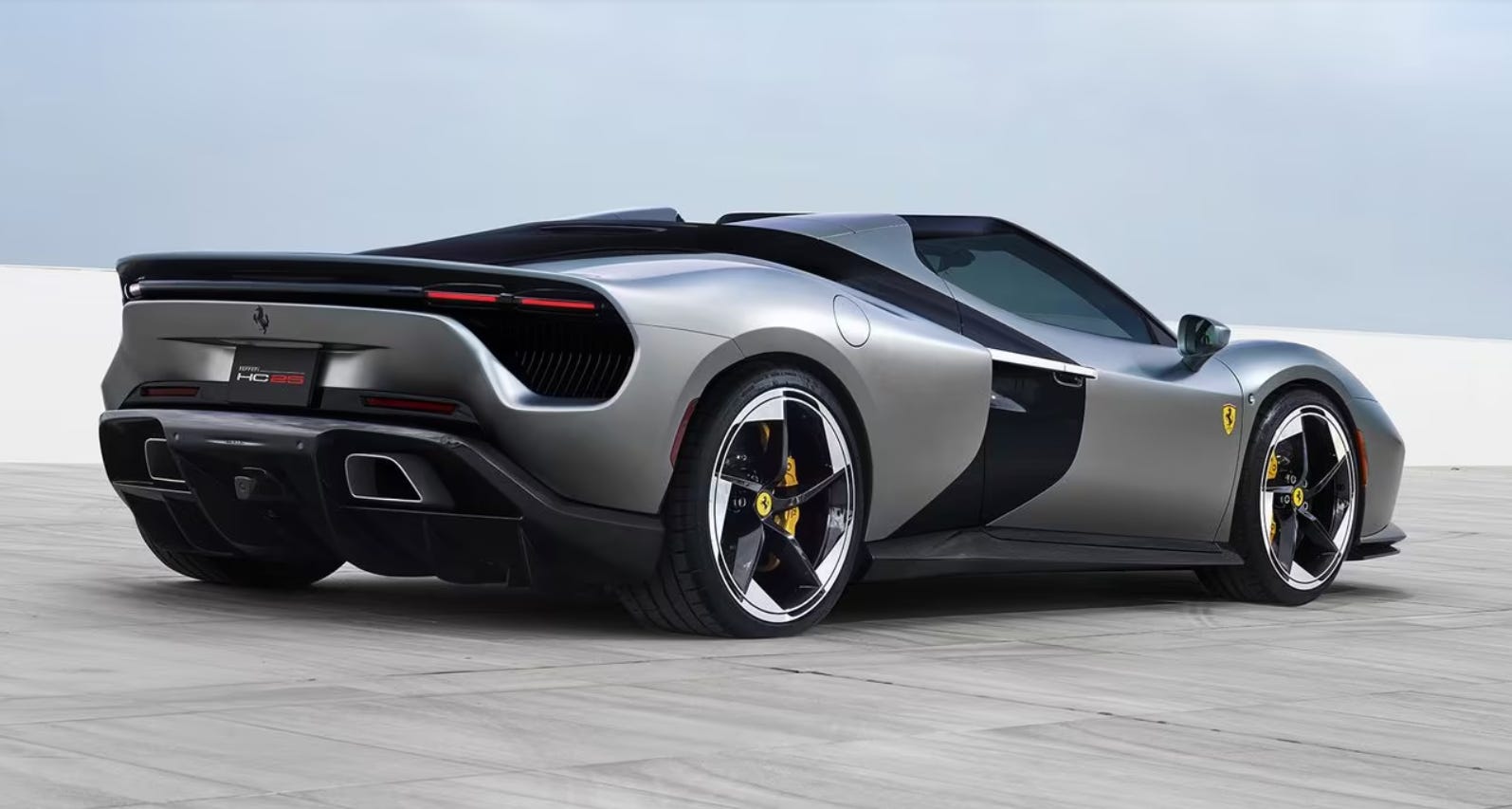
Ferrari’s latest one-off is a privately commissioned roadster from the company’s Special Projects program, based on the F8 Spider and revealed at Ferrari Racing Days at Circuit of the Americas in Texas. Underneath its newly sculpted bodywork sits familiar hardware: the F8 Spider’s mid-mounted, non-hybrid, twin-turbocharged 3.9-liter V8, producing about 710 horsepower and sending power to the rear wheels through a seven-speed dual-clutch transmission. Ferrari claims the HC25 will reach 62 mph in 2.9 seconds, with the broader performance envelope essentially unchanged from the donor car.
The HC25 is not a new series-production Ferrari. It is a one-off, which means it belongs to the very small universe of customers who can ask Maranello not merely for a car, but for a personal interpretation of Ferrari itself.
The platform is the F8 Spider, the last open-top, mid-engined Ferrari powered by a non-hybrid V8. The body, however, is entirely reimagined. Ferrari’s Design Studio, led by Flavio Manzoni, worked with the client over roughly two years to create a car that bridges the F8 era with the current Ferrari design language seen on cars like the F80 and 12Cilindri.
That bridge is the point. The HC25 is old wine in a new glass.
And the HC25 matters because it freezes a disappearing Ferrari formula at exactly the moment the brand is moving away from it.
The standard F8 Spider already occupies an interesting place in Ferrari history. It was the closing chapter for the mid-engined, non-hybrid V8 Spider before the 296 brought electrification into the heart of Ferrari’s junior supercar line. The HC25 takes that mechanical ending and gives it a future-facing body. It is not nostalgic in the obvious sense. There are no retro vents, no1960s gestures, no “remember when” costume drama.
Instead, Ferrari has done something more interesting: it has dressed the last of one era in the language of the next.
That makes the HC25 less a tribute car than a transitional object. It says the V8 past still has emotional power, but Ferrari’s design future is sharper, cleaner, flatter, and less openly mechanical in appearance. The car is significant precisely because it is not a production model. It shows what one extremely well-funded enthusiast wanted preserved: not just speed, but a particular kind of Ferrari sensation before hybrid assistance became part of the recipe.
On paper, the HC25 should drive very much like an F8 Spider, which is hardly a criticism. The F8 was already violently fast, light on its feet, and theatrically responsive for a turbocharged car. The engine is not naturally aspirated opera in the old Ferrari tradition, but it is still a proper internal-combustion centerpiece: immediate, hard-charging, and mounted close enough to make the car feel alive behind your shoulders.
That restraint matters. In an age when every supercar seems desperate to add motors, modes, screens, active systems, and launch-control theater, this one-off keeps the F8’s essential mechanical character intact. The likely compromise is also obvious: this is more design statement than dynamic reinvention.
The HC25 exists above the normal market, but it still tells us something about the market.
For collectors, non-hybrid Ferraris are becoming more emotionally charged. The move toward hybrid systems and eventual electric models may improve performance, but it also changes the story owners tell themselves. A 296 GTB may be quicker, cleverer, and more efficient. But for a certain buyer, the F8 Spider represents the last clean line before the hybrid chapter fully arrived.
The HC25 is exciting, but not because it is faster. It is exciting because it shows a customer using Ferrari’s most exclusive machinery to preserve a kind of purity the regular product line has already moved beyond.
That does not make the HC25 better than a 296, or more important than the F80, or more beautiful than the 12Cilindri. But it does make it fascinating. It is a car built from a moment of tension: between combustion and electrification, old Ferrari sensuality and new Ferrari geometry, private indulgence and public design signal.
The result is a little strange, very expensive, and deeply Ferrari. Which is to say, it is exactly the sort of machine that makes no practical sense and still manages to feel necessary.
Of course, the HC25 is not the future of Ferrari, but it is a beautifully tailored reminder of what Ferrari is leaving behind.
Rev up your passion for automotive art! Everyday Driven is an affiliate of Limited100, the brand turning British craftsmanship into stunning, must-have pieces of art for car lovers worldwide.
Plus, by using our affiliate links, you’ll be supporting Everyday Driven without any ads or subscriptions. Every purchase helps keep our content free and rolling. Check out their site now and find your next favorite piece! Explore their collection and bring home art that speaks to your love for cars.
And you know what would look good on your wall? Ferrari Wall Art from Limited100!