I’ve was going to say I don’t normally write about concept cars, but I then realized I never have, until now. I’m not against them. We’ve all seen something out there we wish would make it to production.
But for me, the Oxia is on another level. And there’s also something deeply inspiring about a sensible company that can occasionally lose its mind.
Peugeot, after all, spent the 1980s making precisely the kinds of automobiles you expected Peugeot to make in the 1980s. Hatchbacks. Sedans. Practical family cars. Some were excellent, some were memorable, and a few were quite entertaining, but nobody wandered into a Peugeot showroom expecting to find a French alternative to a Ferrari F40.
Then, in 1988, Peugeot built the Oxia.
It had a mid-mounted twin-turbocharged V6 producing roughly 670 horsepower, a six-speed manual transmission, four-wheel drive, four-wheel steering, limited-slip differentials at both ends, carbon fiber and Kevlar bodywork, an aluminum structure, magnesium wheels and an electronically adjustable rear spoiler.
And it supposedly reached 217 mph.
This wasn’t a sketch, a clay model or one of those concept cars that needed to be pushed onto the motor-show stand by six embarrassed men wearing Peugeot jackets. The Oxia worked. Two were built. One was taken to the Nardo test track, where Michelin test driver Jean-Philippe Vittecocq reportedly reached approximately 217 mph.
One wonders what sort of meeting takes place inside a company when 186 mph is regarded as the cautious number.
A Peugeot From Another Planet?
The name was appropriate.
Oxia came from Oxia Palus, a region of Mars, and the car really did possess the slightly unsettling quality of an object that had arrived from outer space.
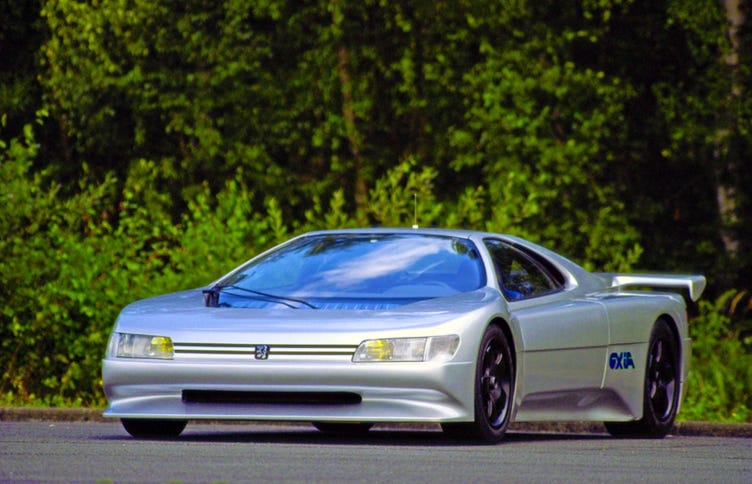
Its shape was recognizably late Eighties, all low nose, steeply raked glass and broad surfaces, but it avoided much of the decorative crap that dates some concept cars. The proportions did most of the work. It was very wide, very low and tightly wrapped around its mechanical components, with the wheels pushed toward the corners and a great sweep of glass occupying much of the upper body.
There was still a Peugeot face at the front, although it looked as though somebody had grafted the family identity onto a machine that had already decided it wanted nothing to do with the family business.
And that tension is part of what makes the Oxia interesting, fascinating even.
It was unmistakably an exotic car, yet it was created by people accustomed to designing Peugeots.
Exotic car manufacturers are expected to behave, well, exotically. Ferrari putting a large engine behind two seats is rather like a bakery producing bread. Porsche engineering some implausibly complicated system to make a car travel faster is simply Porsche being Porsche.
Peugeot doing it is different. The Oxia demonstrated what could happen when the engineering resources of a large mainstream manufacturer were directed toward a problem with almost no requirement for common sense.
The results were extraordinary.
At its center sat the familiar PRV V6, the engine jointly associated with Peugeot, Renault and Volvo and used in forms ranging from luxury cars to decidedly less glamorous machinery. In ordinary service it wasn’t the sort of engine around which high school boys tended to hang bedroom posters.
The V6 was enlarged to roughly 2.8 liters, fitted with 24 valves and subjected to twin turbocharging until output reached somewhere around 670 to 680 horsepower, depending upon the source.
That figure deserves context. The Ferrari F40, introduced only a year earlier, produced 478 horsepower. Porsche’s technologically formidable 959? About 450.
Horsepower figures alone don’t establish superiority, and comparing a prototype to fully developed production cars might not be fair, but the numbers reveal the seriousness of Peugeot’s intent. The Oxia wasn’t designed merely to look as though it could compete with the great supercars of the period. Its engineers had apparently decided it ought to be able to frighten them.
Power went through a six-speed manual gearbox to all four wheels. There were limited-slip differentials front and rear. The rear wheels steered as well as the fronts. Double-wishbone suspension was employed, and enormous Michelin tires attempted to translate all of this French enthusiasm into useful motion.
The body combined carbon fiber and Kevlar over a lightweight aluminum structure at a time when such materials still sounded properly exotic. Depending upon the figure accepted, the complete car weighed somewhere around 3,000 pounds.
The Future, According to 1988
The performance figures are what make the Oxia famous, but the interior may be what makes it charming.
Remember the year.
This was 1988! A mobile telephone was still impressive enough to announce one’s arrival before one had actually entered the restaurant. Compact discs were relatively novel. Satellite navigation belonged considerably more to the imagination than to the average dashboard.
The Oxia had a telephone. It had a computer with a color display. It had an early navigation system that reportedly used a floppy disk.
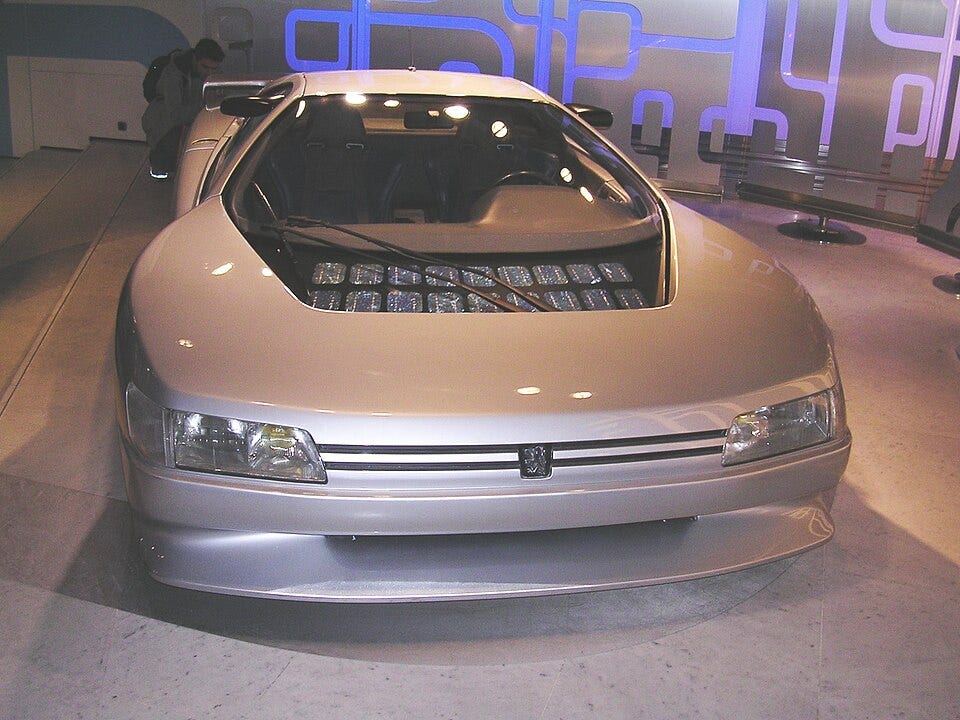
And beneath the windshield sat 18 photovoltaic cells that collected enough energy to keep air circulating through the cabin while the engine was switched off.
Not everything inside was similarly extraterrestrial. Some of the instrumentation retained a distinctly ordinary Peugeot quality, which is perhaps even better. There is something delightful about building a car capable of more than 200 mph, filling it with computer technology and then including switches and gauges that remind you that somewhere in the building there was still a parts department. That mixture of the extraordinary and the familiar is fundamental to the Oxia.
Modern manufacturers frequently demonstrate technological ambition by producing an electric concept with a featureless interior, three acres of touchscreen and doors that open in a manner incompatible with most parking spaces.
The Oxia belonged to another philosophy of the future.
Its technology was complicated, but its purpose was easy to understand. Make the engine more powerful. Make the chassis lighter. Give the tires more help. Drive all four wheels. Steer all four wheels. Use advanced materials.
Then see how fast the thing will go.
Even its more futuristic equipment did not replace the business of driving. The driver still had a steering wheel, pedals and a six-speed manual gearbox. Technology was used to extend the automobile rather than replace the driver.
That makes the Oxia seem strangely modern and old-fashioned at the same time.
Yet Peugeot’s enthusiasm did not emerge from nowhere. The company had already produced the extraordinary Quasar concept in 1984, and its competition programs gave its engineers considerable experience with extremely fast machinery. Sources also draw connections between the Oxia and Peugeot’s developing Group C sports-car work.
One should be careful not to turn resemblance into genealogy. The Oxia was not simply a racing car with license plates, nor was it created as a homologation special.
The Oxia carried the intellectual fingerprints of people who had been spending considerable time thinking about what happened to automobiles at velocities normally associated with light airplanes.
And this is where the car becomes more interesting than its specification sheet.
Concept cars are supposedly opportunities for manufacturers to explore ideas. Yet many concepts explore ideas only cosmetically. They present an exaggerated grille, an impossible interior or a new arrangement of headlights, after which the production version appears two years later looking suspiciously like everything else in the parking lot.
The Oxia explored engineering. Peugeot built the idea far enough to discover whether it actually worked. And that required considerably more commitment than drawing it.
The Supercar Peugeot Did Not Build
It is tempting to treat the Oxia as a great missed opportunity. Had Peugeot put it into production, the argument goes, it might have joined the Ferrari F40 and Porsche 959 among the defining supercars of its era and later competed with machines such as the Jaguar XJ220 and Bugatti EB110.
Perhaps.
But production would have required solving a very different set of problems.
A prototype need only prove that something can be done. A production automobile must prove that it can be done repeatedly, legally, profitably and by customers who possess neither a test track nor Peugeot engineers living in their garage.
The Oxia’s enormous power, unusual structure, complicated four-wheel-drive system, rear steering and advanced electronics would all have become rather more troublesome once warranties, crash regulations, emissions requirements, dealer servicing and manufacturing tolerances entered the conversation.
Then there was Peugeot itself.
Selling a Peugeot at supercar money would have required buyers to ignore one of the most powerful forces in the automobile business: the badge on the nose. (Didn’t Volkswagen try that?)
A Ferrari buyer was purchasing far more than horsepower. So was a Porsche buyer. Peugeot could match their engineering figures more easily than it could manufacture their mythology.
Production has a habit of forcing wonderful ideas to become responsible adults.
The Oxia never had to grow up.
The Oxia was created by a manufacturer whose ordinary business depended upon restraint, cost control, repeatability and practicality. Yet somewhere inside Peugeot there remained enough curiosity to ask what might happen if those restrictions were temporarily removed.
The answer was not a styling exercise. It was a 217-mph automobile.
That is why the Oxia deserves to be remembered. Automotive history needs those moments.